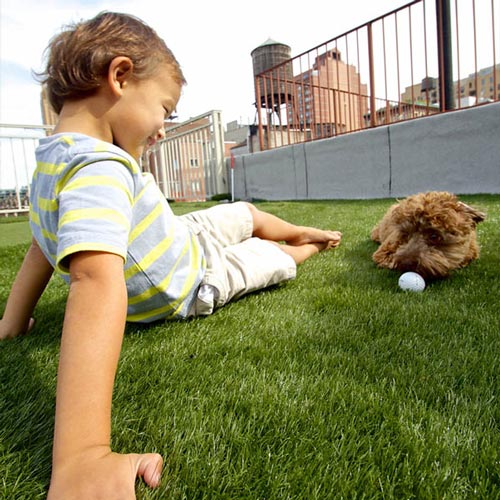
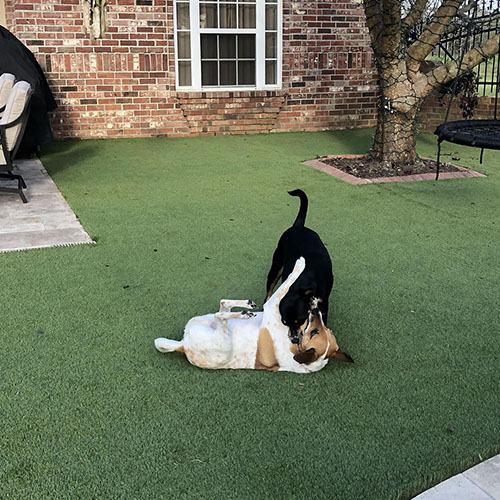
If you have dogs in Boise and you’re looking at artificial grass for dogs, safety is probably the first thing on your mind. Is it toxic? Will it get too hot for their paws? What happens when they do their business on it? Can they dig through it? These are the questions every pet owner asks – and they deserve honest, straightforward answers. This guide covers everything dog owners in Boise need to know about artificial grass safety before making a decision.
Is Artificial Grass Toxic to Dogs?
This is the most important question and the one pet owners most commonly ask first. The short answer is no – quality artificial grass is non-toxic and safe for dogs.
SYNLawn products are lead-free and manufactured without heavy metals or toxic compounds. They meet or exceed the safety standards required for residential use around children and animals. There are no pesticides, herbicides, or fertilizers in the product itself – and once artificial grass is installed, none of those chemicals ever need to be applied to it.
One important clarification: artificial grass products vary significantly in quality, and not all are manufactured to the same standard. Cheap imported turf products may not meet US safety standards. This is one of the reasons sourcing from a reputable manufacturer like SYNLawn – with US-based manufacturing and documented safety testing – matters when you have dogs.
Will Artificial Grass Get Too Hot for My Dog’s Paws?
This is a legitimate concern and one worth taking seriously. Artificial surfaces do absorb heat in direct sunlight, and in Idaho’s hot summers – where temperatures regularly exceed 90°F in Boise – surface temperature is a real consideration for dog owners.
SYNLawn’s HeatBlock technology reduces surface temperature by up to 20% compared to standard artificial turf products. This is a meaningful difference in conditions where surface temperature is a concern.
Furthermore, dogs’ paw pads are tougher and more resilient than human skin, so there have been no issues with dog safety in the past.
Practical steps that help manage surface temperature:
- Provide shaded areas – a pergola, shade sail, or tree canopy over part of the turf area significantly reduces surface temperature in that zone
- Rinse with water – running a garden hose over the turf for a minute or two drops the surface temperature quickly and keeps it comfortable for dogs
- Time outdoor access – during peak heat in Idaho summers, limit the time dogs spend on any outdoor surface during the hottest part of the day, regardless of surface type
The temperature consideration is real – but it’s manageable, and SYNLawn’s HeatBlock technology makes a meaningful difference compared to standard artificial turf.
What Happens When Dogs Go to the Bathroom on Artificial Grass?
This is the practical question that matters most for day-to-day life with dogs. Here’s exactly how it works:
Liquid waste drains directly through the turf and the permeable base layer beneath it – the same way rain drains. A properly installed pet turf system drains quickly and completely, leaving no pooling on the surface. For households with multiple dogs, a weekly rinse with a garden hose keeps the drainage system flushing through regularly and the surface fresh.
Solid waste is picked up exactly the same way as on a natural lawn – nothing different there. After pickup, a quick rinse of the area is all that’s needed.
Odor is the concern most dog owners have – and it’s the one where infill selection makes all the difference. SYNLawn Idaho specifies antimicrobial infill for all pet installations as standard. This infill actively inhibits bacterial growth at the fiber level – it doesn’t just mask odor, it prevents it from developing at the source. A pet turf installation with the right infill and regular rinsing does not develop persistent odor.
The key word there is “properly installed.” A pet turf system with poor drainage or standard sand infill will develop odor problems. A system installed correctly with antimicrobial infill and good drainage will not.
Explore SYNLawn Idaho’s pet turf systems
Can Dogs Dig Through Artificial Grass?
Dogs can damage artificial turf if they are determined diggers – this is worth being honest about. Artificial grass is more resistant to digging than natural grass, and the secured edges make it harder for dogs to get underneath the turf, but a dog that is motivated to dig can work at any surface given enough time.
A few things that reduce the risk:
- Secured edges: A properly finished installation with well-secured perimeter edging removes the most accessible starting point for a dog trying to get under the turf
- Fiber selection: Some turf products have more robust fiber construction that resists pulling and tearing better than others
- Dog behavior: Most dogs that dig in natural grass do so out of habit or because the soil is loose and satisfying to dig in – artificial turf doesn’t provide the same tactile reward, and many dogs lose interest in digging once the surface changes
For breeds with strong digging instincts – terriers, dachshunds, huskies – it’s worth discussing the specific installation approach with SYNLawn Idaho during the consultation.
Is Artificial Grass Comfortable for Dogs to Lie On?
Yes. High-quality artificial grass from SYNLawn is soft underfoot and comfortable for dogs to walk, run, and rest on. The pile height, fiber softness, and infill depth all contribute to the feel of the surface – and a properly specified installation is noticeably softer and more pleasant than hard surfaces like concrete or gravel.
The one caveat is temperature, covered above – on very hot summer days in Boise, the turf surface in direct sun will be warmer than a shaded area, and dogs should have access to a cooler spot during peak heat.
What About Dogs That Eat Grass?
Some dogs eat natural grass – it’s a common behavior with various explanations, most of them benign. With artificial grass, this behavior is worth monitoring. SYNLawn products are non-toxic, so occasional contact with or mouthing of the turf is not a safety concern. However, artificial grass is not designed to be consumed, and dogs that consistently chew or eat the turf fibers should be discouraged.
Most dogs show no interest in eating artificial grass – the texture and taste are very different from natural grass. Puppies may investigate it during the settling-in period, which is normal, and usually move on quickly.
How Do You Keep Artificial Grass Clean With Dogs?
The maintenance routine for a pet turf yard is simple:
- Daily or as needed: Remove solid waste
- Weekly: Rinse the entire surface with a garden hose – this flushes liquid waste through the drainage system and keeps the surface fresh
- For multiple dogs: Two to three rinses per week is better than one
- Occasionally: For any persistent odor, a diluted enzyme cleaner applied to the surface and rinsed through handles it completely
- Monthly: Brush the surface with a stiff broom to keep fibers upright in high-traffic areas
That’s the complete routine. No mowing, no fertilizing, no mud management. Most dog owners find it significantly less work than maintaining a natural lawn with dogs.
Is Artificial Grass Better Than Natural Grass for Dogs?
For most Boise dog owners, yes – practically speaking. Here’s why:
Natural grass with dogs has predictable problems: dead patches from urine, mud from digging and heavy traffic, chemicals from treatments that dogs are directly exposed to, and a surface that looks rough within a season of regular dog use.
Artificial grass eliminates all of those problems. The surface stays consistent under heavy use, there are no chemicals applied to it, and a properly installed pet system handles waste hygienically without developing odor.
The one area where natural grass has an advantage is the living surface quality – real soil, real grass, the natural environment dogs evolved in. For dogs that spend extensive time outdoors and have access to parks and open spaces, this may be less of a factor. For urban and suburban dogs in Boise whose primary outdoor space is a backyard, artificial grass delivers a cleaner, more usable environment.
Get a free pet turf consultation from SYNLawn Idaho
Frequently Asked Questions
What artificial grass is safest for dogs?
Look for turf from manufacturers with documented safety testing – lead-free certification, no heavy metals, and US-based manufacturing. SYNLawn products meet all of these criteria and are specifically engineered for pet applications with antimicrobial infill and enhanced drainage.
Can artificial grass cause skin irritation in dogs?
Quality artificial grass from a reputable manufacturer does not cause skin irritation in dogs. Cheap, low-quality products may use rougher fiber materials that could cause discomfort with extended contact – another reason to source from a quality manufacturer.
How long does pet turf last with large dogs?
A properly installed SYNLawn pet turf system is designed to last 15 to 20 years even under heavy use from large dogs. The fiber construction and antimicrobial infill are specified to handle sustained pet activity.
Can I install artificial grass in a dog kennel or run?
Yes. Artificial turf is an excellent surface for dog kennels and runs – it’s comfortable underfoot, drains well, is easy to clean, and eliminates the mud that makes natural surfaces in high-use dog areas difficult to manage. SYNLawn Idaho installs pet turf in kennel and run configurations regularly.
Does artificial grass affect dogs with allergies?
Many dog owners with allergic dogs find that artificial grass actually reduces allergy triggers – no pollen from grass, no mold from damp organic material, and no chemical treatments applied to the surface. Every dog is different, but artificial grass is generally considered a lower-allergen environment than natural grass for sensitive animals.
Will my dog know the difference between artificial and natural grass?
Most dogs adapt to artificial grass quickly – usually within a day or two. The texture feels different from natural grass, but dogs are adaptable and most treat the new surface as normal outdoor space within a short settling-in period.